
Location:Home > Pharmaceutical
Details
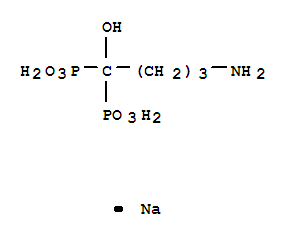
Top Quality Chinese Factory supply 129318-43-0 Alendronate sodium
- Molecular Formula: C4H13NO7P2.Na
- Molecular Weight: 272.08
- Melting Point: 119 °C
- Boiling Point: 616.7oC at 760 mmHg
- Flash Point: 326.7oC
- PSA: 180.93000
- LogP: -0.46040
Alendronate sodium(Cas 129318-43-0) Usage
|
Synthesis of Alendronate |
It uses gamma-aminobutyric acid (GABA), phosphorous acid, phosphorus trichloride as the raw material and uses the diphenyl ether as the solvent to prepare the alendronic acid, and then alkalesizes to obtain its monosodium salt. The synthesis is shown below: Image 1: Synthesis of Alendronate sodium |
|
Side effects |
After medication tolerance well, a small number of patients can be seen gastrointestinal reactions, such as nausea, abdominal distension, abdominal pain, occasional headache, skeletal muscle pain, rare rash and erythema. The overview of Alendronate sodium, synthesis, adverse reactions, precautions, etc. is edited by lookchem's Li Jie. (2016-01-22) |
|
Taboo |
1.Esophageal motility disorders, such as the disability of esophageal delay and the esophageal stricture are disabled. 2.Severe renal insufficiency is disabled. 3.Osteomalacia is disabled. 4.Allergies with the goods and other bisphosphonates, hypokalemia are disabled. 5.Pregnant, lactating women and children are disabled. |
|
Note |
1. At least 30 minutes before breakfast with 200ml warm water delivery; medication at least 30 minutes before eating. 2. Taking with orange juice and coffee at the same time will significantly affect the absorption of the product. 3. In taking this product before and after 30 minutes, drinking milk, dairy products and drinks with more calcium are not allowed. Immediately lying in bed after taking medicine may cause esophageal irritation or ulcerative esophagitis. 4. Gastrointestinal disorders, gastritis, esophageal discomfort, duodenitis, ulcer patients should use this drug with caution. 5, Mild to moderate renal dysfunction in patients should use this drug with caution. 6. Before starting to use this product treatment, calcium metabolism and mineral metabolism disorders, vitamin D deficiency and hypocalcemia must be corrected. Calcium supplements, antacids and some oral agents are likely to hinder the absorption of the product. Therefore, after taking this product, the time should be delayed at least half an hour and then taking other drugs. 7. If the food intake is not enough, all patients with osteoporosis should be added calcium and vitamin D. |
|
Drug interactions |
1. Antacids and cathartic agents will often affect the absorption of the drug for containing calcium or other metal ions such as magnesium, iron and so on. 2. Inducing hypocalcemia when in combination with aminoglycosides. |
|
Pharmacokinetics |
The second-generation agent alendronate sodium was the first bisphosphonate agent approved by the U.S. FDA for the prevention and treatment of osteoporosis and Paget's disease of the bone and is 1,000-fold more potent than etidronate. This derivative, when dosed continuously (5–10 mg/day for osteoporosis and 40 mg/day for Paget's disease) and given with oral calcium supplements (500 mg/day), produced well-mineralized bone and significantly improved BMD (7% in the spine and 4% in the hip) within 18 months. In addition, the vertebral fracture rate was shown to decrease by 47%. A side effect associated with alendronate, chemical esophagitis, has been attributed to inadequate intake of water and lying down after taking the medication. Specific patient instructions were developed to limit the incidence of upper gastrointestinal problems and include: 1) taking the medication with 6 to 8 ounces of water on arising in the morning, 2)remaining in an upright position for at least 30 minutes after taking the medication, and 3) delaying drinking other liquids/eating for at least 30 minutes, if not 1 to 2 hours, to allow maximal absorption of the agent. To enhance absorption, calcium supplements and any aluminum- or magnesium-containing antacids should be dosed separately from the agents in this class. |
|
Overview |
Alendronate sodium is the world's most widely used anti-osteoporosis drugs, listed in the United States in 1993. It can significantly increase bone mineral density, reduce fracture risk, and it is the first-line treatment of osteoporosis drugs. Alendronate sodium is a resorption inhibitor of aminodiphosphonate bone, and has a strong affinity with bone hydroxyapatite. It can enter the bone matrix hydroxyapatite crystals. When the osteoclast dissolved crystals, the drug was released, causing the inhibition of osteoclast activity, and playing anti-bone resorption activity indirectly through the inhibition of bone resorption of osteoblasts. It possesses the characteristics of the activity of anti-bone resorption and with no bone mineralization. Clinically used for the treatment of postmenopausal women with osteoporosis, to prevent hip and spine fractures. |
|
Brand name |
Alendros |
InChI:InChI=1/C4H13NO7P2.Na/c5-3-1-2-4(6,13(7,8)9)14(10,11)12;/h6H,1-3,5H2,(H2,7,8,9)(H2,10,11,12);/q;+1/p-1
Relative Products
- 3-(Trimethoxysilyl)-1-propanamine
- Methyl vinyl ether/maleic acid copolymer
- Panipenem
- L-Hydroxyproline
- 4,4',4''-(1-methylpropan-1-yl-3-ylidene)tris(2-cyclohexyl-5-methylphenol)
- Potassium silicate
- Rhodium sulfate plating solution
- Diflunisal
- 2'-Deoxy-L-thymidine
- 2-Ethyl-1,3-hexanediol
- 26-(nonylphenoxy)-3,6,9,12,15,18,21,24-octaoxahexacosan-1-ol
- Isopropylphenyl phosphate
- DI(TRIDECYL) ADIPATE
- Furfuryl methacrylate
- 3-Methoxy-4-hydroxycinnamyl β-D-glucopyranoside
- DL-Phenylephrine hydrochloride
- 2-Aminoadamantane
- 2,2-DICHLORO-1,1-DIFLUOROETHYL METHYL ETHER
- 2,2-Dimethoxybutane
- Hinokitiol